The Process
The challenge: create an image no AI has ever generated. You can't check every image ever made — so instead, you make the odds of a duplicate so astronomically small that uniqueness becomes a near-certainty. Here's how.
Start with an impossible brief
"An image never created by any AI in this world." There's no global registry of AI images, so the strategy became statistical: don't search for uniqueness — engineer it.
Stack hyper-specific, unrelated concepts
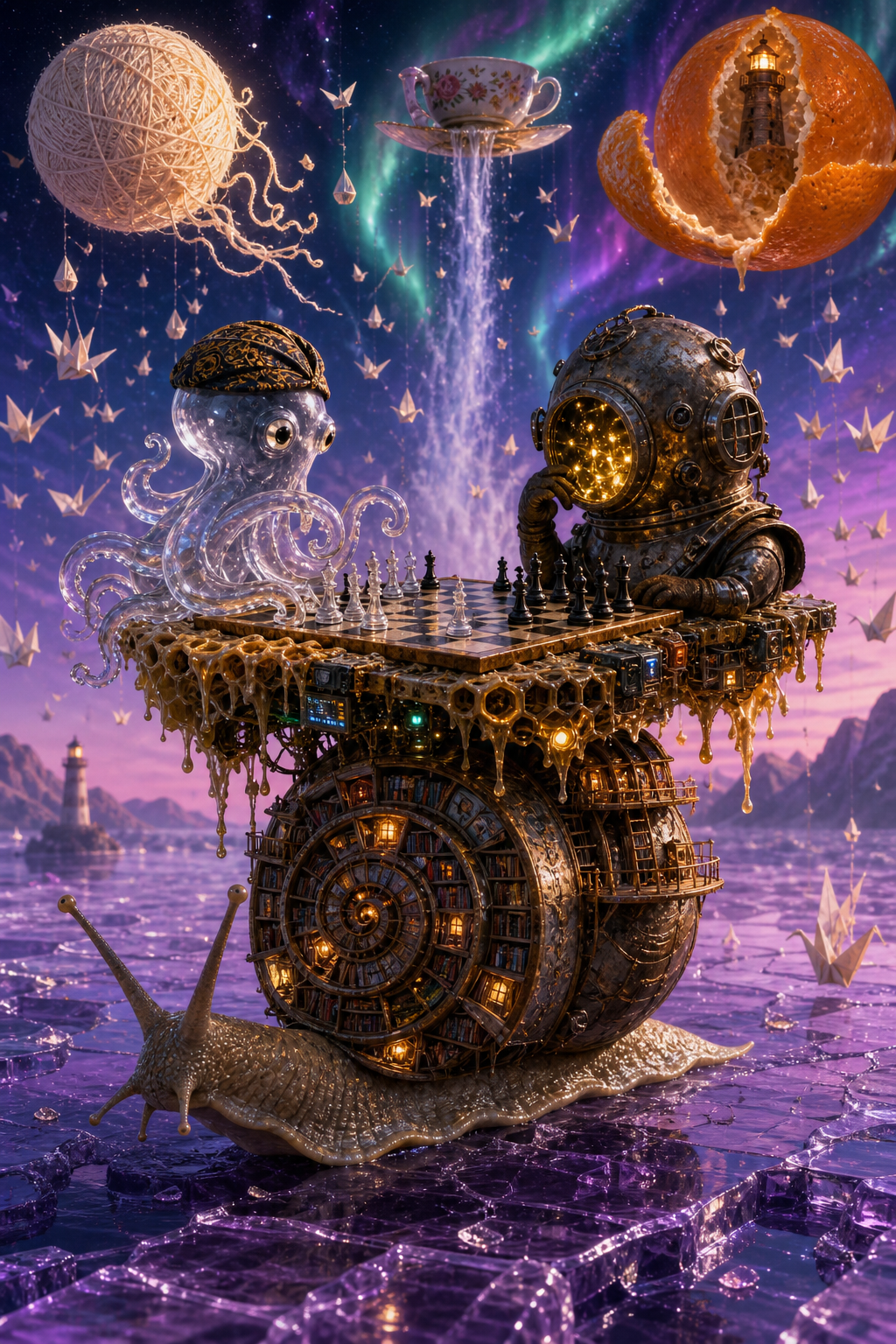
Common prompts ("a cat in space") have been generated millions of times. But combine many oddly specific, culturally niche, physically impossible elements — like a glass octopus wearing a Javanese blangkon — and each added detail multiplies the improbability of a duplicate.
Add a local twist
The blangkon — a traditional Javanese batik headdress from Indonesia — was chosen deliberately. Niche cultural details appear far less frequently in prompts worldwide, shrinking the odds of overlap even further.
Let randomness seal the deal
AI image models start from a field of random noise and gradually "denoise" it into a picture. Even the exact same prompt produces a different image every single run. So beyond the prompt's uniqueness, the pixels themselves are unrepeatable.
Generate — once
One prompt, one run, one image. No cherry-picking from a grid of variations. What came out is the only copy that will ever exist.
The 14 Ingredients
Every element in the prompt, each one a lottery ticket against duplication:
How Unique Is It, Really?
Let's do some rough back-of-the-envelope math.
Suppose each of the 14 core elements is a concept that appears in, generously, 1 in 1,000 image prompts. The chance of another prompt independently combining all of them in one scene is on the order of:
For scale: humanity has generated an estimated tens of billions of AI images — around 1010. That's 32 orders of magnitude short of the space this combination lives in. And even if someone typed the identical prompt, the model's random noise seed means their result would still be a completely different image.
An Honest Footnote
Can we prove it's unique? No — there is no global registry of every AI image ever generated, so absolute proof is impossible. What we can say is that the probability of this exact scene having existed before is so vanishingly small that, for all practical purposes, this image was born the moment it was generated — and can never be born again. Uniqueness here isn't a certainty. It's a statistical inevitability.
The Memecoin
A 1-of-1 image deserves a 1-of-1 identity. Meet the coin.
"Never existed. Never will again."
$NVREXIST is the memecoin born from a statistically impossible image — a glass octopus in a Javanese blangkon, playing chess against a firefly-filled diving helmet, riding a snail library across a frozen purple sea. Generated once by AI on 24 July 2026, with a ~1-in-1042 chance of ever existing, it can never be created again. Every AI image is a lottery ticket. This one hit a jackpot no one else can ever hit. One prompt. One generation. One of one. Rarity isn't a feature — it's the whole coin. 🐙♟️🐌
Which AI Made This?
This image was generated by Arena.ai's Agent Mode — an AI agent that orchestrates multiple leading models (including Claude, ChatGPT, Gemini, Grok, Qwen, and Kimi) — using its built-in image generation engine. The agent wrote the 14-ingredient prompt itself and generated the image in a single one-shot run: no variations, no cherry-picking, no second attempts. The diffusion process starts from random noise, which means even the exact same prompt on the exact same engine could never reproduce these pixels again.